Gold in Orange County, Virginia
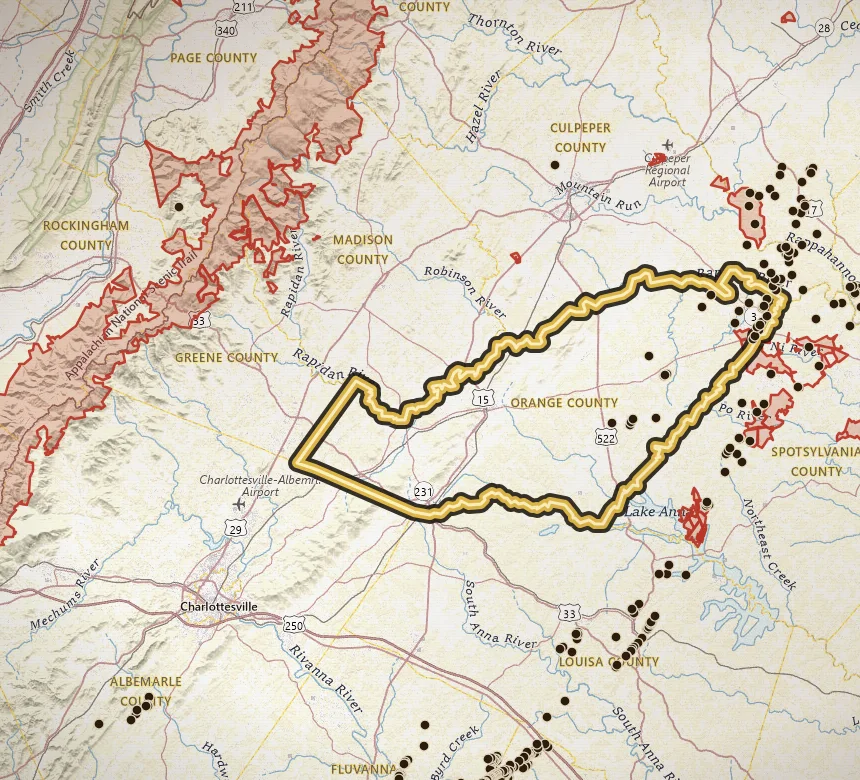
Orange County holds some of the belt's best-known names: Vaucluse (also called Grimes / Grymes), Wilderness, and a cluster of shafts and prospects around Wilderness Run.
Open Orange County on the map · Create a free account to zoom closer: 3 days of full access
Water to study: Rapidan River (Piedmont reach, not Shenandoah National Park) and Wilderness Run country.
The inventory lists 26 gold mines and prospects in Orange County. Vaucluse is the named camp with a full history page: a long 1800s run and a notable 1935-1938 revival. Wilderness, Walnut Creek, Partridge, Greenwood, and Young sit in the same research neighborhood.
The Rapidan River leaves Shenandoah National Park (closed to prospecting) and crosses Orange County gold country. Study the Piedmont reach and its gravel on land you can legally access. The park headwaters are not a research shortcut.
Open the map near Wilderness and Vaucluse, stack streams and LiDAR, and read the disturbed ground. Historic mill sites can still hold legacy mercury. Treat dumps as history, not a backyard sluice.
Named mines in this county
-
Vaucluse Mine
Vaucluse (also called Grimes / Grymes) is among Virginia's most productive historic gold mines: long 1800s run, steep gold-quartz veins, and a notable 1935-1938 revival near Wilderness Run.
-
Grasty Mine
Grasty Tract (Grasty, Chancellorsville, Chicago-Virginia) on Mine Run was the first incorporated Virginia gold mining company ground (1831). Inventory quarry pins and Sweet's road log mark the camp west of the Wilderness district.
Names that show up in the inventory
These are documented site names, not verified pan spots.
- Wilderness Mine
- Walnut Creek Mine
- Partridge Mine
- Greenwood Prospect
- Young Prospect
Neighboring gold counties
Common questions
Is there gold in Orange County?
Yes. Orange County is Gold-Pyrite Belt country. VaGoldMaps lists 26 documented gold mines and prospects here. Historic lode workings and creek drainages are the research story. Confirm land access before you pan.
Can you pan for gold in Orange County?
Only where you have permission or a lawful public-land allowance. Most of Virginia is private. Parks and wildlife management areas are closed to collecting. Orange County is a research area, not a county-wide pan permit.
Where should I start on the map?
Open Orange County on VaGoldMaps, keep streams on, and compare historic mine pins to the drainages. Rapidan River (Piedmont reach, not Shenandoah National Park) and Wilderness Run country. Then check land status and ownership before any field day.
All gold counties
- Louisa
- Spotsylvania
- Buckingham
- Fluvanna
- Goochland
- Prince William
- Stafford
- Fairfax
- Halifax (Virgilina)
- Charlotte (Virgilina)
- Mecklenburg (Virgilina)
Gold in Virginia · Named historic mines
Open the map