Gold Claims Out West: Patented vs Unpatented
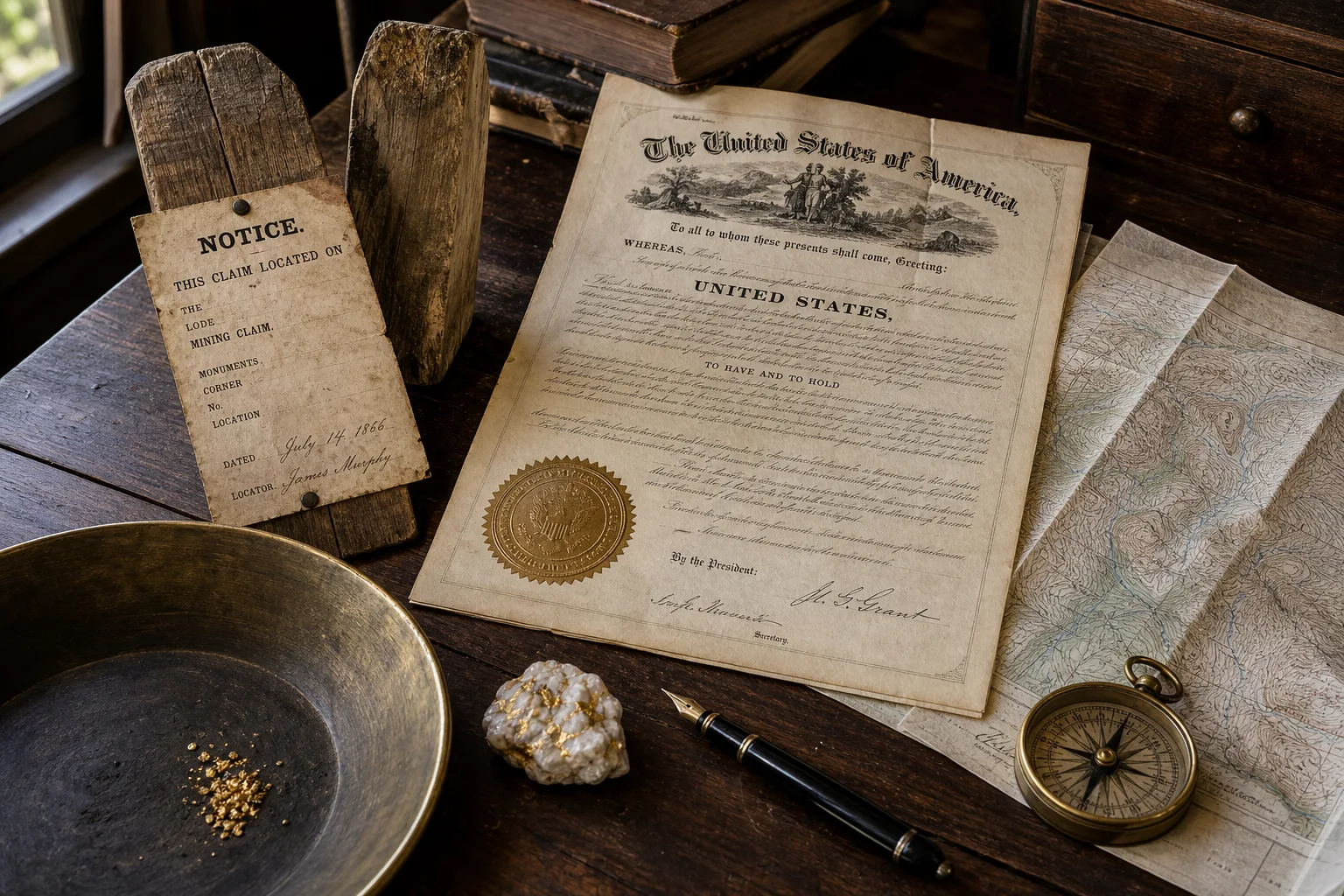
Western gold talk is full of the word claim.
People use it for a creek they like, a YouTube spot, a club lease, and actual federal mining law. Those are not the same thing. Mixing them up is how recreational panners end up on someone else's mineral right, or on a ranch that used to be a claim and is now just private land.
Out West, under the General Mining Law of 1872, there are two federal animals that still matter:
- An unpatented mining claim: you have a possessory right to locatable minerals. The United States still owns the land.
- A patented mining claim: the United States already passed title. It is private ground, usually including the surface.
This note is research context, not legal advice, and not a how-to for staking anything. If you need a determination on a specific parcel, that is BLM, a title attorney, and the county, not a blog post.
Where the 1872 law actually runs
The General Mining Law of 1872 lets U.S. citizens locate mining claims on federal land that is still open to mineral entry. That is a public-domain story. It is not a nationwide hobby license.
BLM lists 19 states where you may locate a mining claim or site on open federally administered land:
Alaska, Arizona, Arkansas, California, Colorado, Florida, Idaho, Louisiana, Mississippi, Montana, Nebraska, Nevada, New Mexico, North Dakota, Oregon, South Dakota, Utah, Washington, and Wyoming.
In those states, BLM usually manages the mineral estate. On National Forest System land, the Forest Service manages the surface and BLM still administers the claims. An unpatented claim on a National Forest creek is still a BLM record.
Only public-domain minerals (minerals that never left federal ownership, plus certain reconveyed minerals) are locatable. Acquired minerals are a different pile. You do not stake an 1872 claim on them.
Source: BLM, Locating a Mining Claim
Unpatented: minerals, not the ranch
An unpatented mining claim is a possessory interest in locatable minerals. Gold, silver, and other hardrock minerals sit in that bucket. The locator did not buy the mountain.
The United States keeps title to the land. Other people may still hike, hunt, or camp under the surface rules for that forest or BLM district. They may not take the claimant's minerals. Panning, sluicing, or digging gold on an active unpatented claim without permission is not casual recreation. It is taking someone else's mineral right.
To stay alive, an unpatented claim has to be maintained. That usually means an annual maintenance fee to BLM (or a qualifying small-miner waiver) and a discovery of a valuable mineral deposit if the United States ever challenges validity. A faded post in the willows is not, by itself, proof the claim is good.
Unpatented claims come in the usual western types:
- Lode: a vein or mineral in place, the quartz-in-the-hill story
- Placer: loose gold in gravel, sand, or soil
- Mill site and tunnel site: support locations, not extra gold creeks
You can mine locatable minerals from a valid unpatented claim without ever patenting it. Most working western claims today are unpatented. Patenting is no longer the on-ramp.
Patented: it became private land
A patented mining claim is one where the federal government passed title to the claimant.
BLM's own sentence is the one to keep: exclusive title to the locatable minerals and, in most cases, the surface and all resources. After patent, it is not "public land with a claim on it." It is private land. County tax rolls, no-trespassing signs, houses, hay fields, and gated roads are what that looks like on the ground now.
Nineteenth-century and early twentieth-century western camps are full of these rectangles. The lode got patented. The mill site got patented. Fifty years later someone built a cabin on it, or a subdivision ate the gulch. The gold story is in the deed history. The access story is ordinary private property.
Unpatented claim
- United States still owns the land
- Claimant has the locatable minerals
- BLM record, annual maintenance
- Other public uses may still exist on the surface
- Taking gold without permission is claim jumping
Patented claim
- Title has left the United States
- Usually minerals and surface
- County deed, not a live BLM claim file
- It is private land
- Entry without permission is trespass
Why new patents stopped in 1994
Effective October 1, 1994, Congress put a spending moratorium on BLM accepting or processing new mineral patent applications that had not already reached a defined point in review. BLM will not take new patent applications until Congress lifts that bar.
That is why western forums still argue about patents as if they were a current purchase price of $5 an acre. For practical purposes, the patent window is closed. Unpatented claims remain. They just stay unpatented.
Older patents already issued are still real. They did not revert to the forest because the moratorium passed.
Source: BLM, Patents
Lode, placer, mill site
YouTube collapses all of this into "a gold claim." The paperwork does not.
A lode claim follows a vein or mineralized zone in place. Historic western gold camps were often lode first: quartz, stopes, dumps, then a mill. A placer claim covers gold already loose in gravel. Same metal, different legal description of the deposit.
A mill site is not a second gold deposit. It is ground used to support a claim (mill, tailings, shop). Patenting a mill site could put private rectangles next to a creek that never produced a flake for the mill owner. Reading an old survey plat without knowing that difference is how people decide a whole drainage "was claimed" when only the mill bench was.
None of that is a treasure map. It is a property description.
What this means if you want to pan
On western public land that is open to mineral entry and not covered by a claim, recreational hand panning is often treated as casual use: small tools, little surface disturbance, no permit. Districts still set local limits. Wilderness, withdrawals, and seasonal closures punch holes in that sentence. Ask the ranger district or BLM field office for the unit you are actually standing in.
On an unpatented claim, the minerals are not yours to take. Walk through if the surface rules allow it. Leave the pan in the truck unless the claimant said otherwise.
On a patented claim, treat it like any other private parcel. The fact that it used to be a mine does not reopen it. Historic workings on patented ground are still someone's land, and often someone's liability.
Open federal, no claim
Casual panning may be allowed. Confirm the unit, the withdrawals, and the local tool rules.
Unpatented claim
Public land, private minerals. Do not remove gold without the claimant's permission.
Patented claim
Private land. A historic mine name on a map is not an invitation.
Park, wilderness, withdrawal
Usually closed to new claims and often closed to collecting. National Parks are the cleanest no.
How claims show up in the records
Live unpatented claims are federal mineral records. BLM's Mineral & Land Records System (MLRS) is the public index. Serial numbers, claimant names, claim type, and location descriptions live there. Geometry is only as good as the legal description behind it. A GIS polygon is a sketch of a filing, not a surveyed pin you can argue with a sheriff.
Patented claims often drop out of the live mining-claim layer once title passes. After that you are in county deeds, tax parcels, and old mineral survey plats (Mineral Survey / MS numbers on topographic maps). "MS 1234" on a USGS sheet is a breadcrumb to a patented survey, not a creek that is still federal.
Club ground (GPAA and similar) is usually a lease or a club-held claim, not a personal patent. Read the club's own rules. They are not the 1872 statute in plain English.
Source: BLM Mineral & Land Records System
Ground that is not open to claims
Even inside the 19 states, large areas are withdrawn from mineral entry. BLM's locating page lists the usual closed pile:
- National Parks and National Monuments
- Indian reservations
- Military reservations
- Many reclamation and wildlife areas
- Wilderness (new location stopped; some old valid claims were grandfathered)
- Wild and Scenic River corridors and study buffers
National Park Service units are the rule Virginia readers already know: no prospecting, no mineral collecting, no claims. That is true in California and Colorado too. A western park boundary is not "Forest Service, but prettier."
See our notes on National Park boundaries and prospecting on National Forest for how those lines read on Virginia ground. The western claim layer sits on top of the Forest Service story, not instead of it.
Why Virginia prospectors keep hearing this
Virginia is not on BLM's list of states where you locate 1872 mining claims. Eastern National Forests were mostly bought under the Weeks Act, not reserved from public domain. You do not plant posts on a Louisa County creek and mail a location certificate to Springfield.
What Virginia gold research actually runs on:
- Private deeds and, sometimes, severed mineral rights under state property law
- Historic mines that sat on plantations and company land, not federal mineral patents
- Casual-use panning questions on George Washington and Jefferson National Forests
- Closed parks and WMAs
A colonial land patent in a Virginia courthouse is a grant of land from the Crown or the Commonwealth. It is not a BLM mineral patent. Same English word. Different pile of paper.
If your plan is a western trip, learn claims before you go. If your plan is the Gold-Pyrite Belt, start with the Virginia Gold guide and the map, not with MLRS.
Land access reminder
A claim name, a mine tick, a Mineral Survey number, or a YouTube waypoint does not mean you may enter, detect, dig, or pan there.
Unpatented claims: the minerals are not public just because the land still is. Patented claims: private land. Most Virginia gold ground is private for an even simpler reason. It was never federal mineral entry country.
VaGoldMaps is for research and education, not land access, claim status, or digging advice. Confirm ownership and the managing agency before anyone's boots hit the creek.
Sources
- Bureau of Land Management, Locating a Mining Claim (19 states, public-domain minerals, withdrawals).
- Bureau of Land Management, Patents (what a patented claim conveys; 1 October 1994 moratorium).
- Bureau of Land Management, Mining Claims and Sites on Federal Lands (unpatented possessory interest vs patented title).
- BLM Mineral & Land Records System (live unpatented claim index).
- U.S. Forest Service surface rules on National Forest System land: 36 CFR 228 Subpart A.
On this site:
- Can you prospect for gold in National Forests?
- National Park boundaries (closed)
- Virginia Gold: Belt, Creeks & How to Research It
Questions this mix-up always raises
Can I stake a gold claim in Virginia?
Not under the 1872 location system. Virginia is not one of the 19 states where BLM says you may locate a mining claim on open federal land. Virginia gold research is deeds, historic mines, and agency rules, not posts in a creek.
If a claim is unpatented, is the gold public?
No. The land may still be federal. The locatable minerals on a valid unpatented claim belong to the claimant. Recreational panning without permission is not a loophole.
If a claim is patented, can I still pan the creek?
Not as public land. Patent usually took the surface too. You need the owner's permission, the same as any other private parcel. A historic mine name does not keep it federal.
Can I still patent a claim?
BLM has not been accepting new mineral patent applications since 1 October 1994. Existing unpatented claims can still be held and maintained. They do not convert to deeds under the old $5-an-acre story unless Congress changes the moratorium.
How do I know if a western creek is claimed?
Start with BLM MLRS for live unpatented claims, then the local BLM field office or Forest Service ranger district. For patented ground, use county parcels and old mineral survey numbers. A phone-map pin is not a title search.
Final thought
Western gold country still runs on two pieces of paper. One is a location that leaves the land with the United States. The other is a patent that does not.
Learn which one you are looking at before the pan goes in the water.
If you are researching Virginia instead, skip the claim posts. Open the map, read the belt, the creeks, and the red park line, and treat private ground as private.